

Description
Use Your Brain 8 – Kids Brain Games, Math & Logic Puzzle Workbook (Bilingual Arabic–English, Ages 4–8, Printable PDF) is an autumn-themed children’s activity book filled with smart, screen-free challenges. It combines fun brain games for kids with early maths, logic and observation skills, all presented on large notebook-style pages that are easy for young children to understand and enjoy.
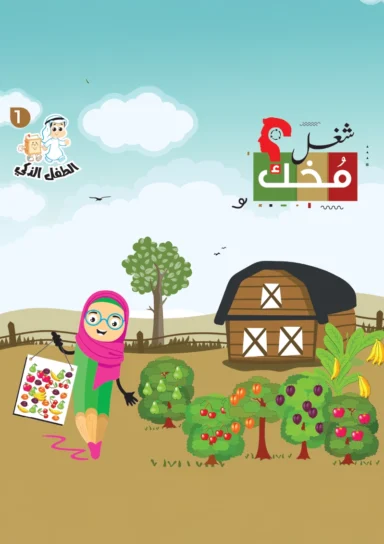
On the cover, a friendly pencil girl walks through golden wheat fields holding a sheet of bird silhouettes, while a white dove flies past carrying a letter. The warm orange sky and trees set the tone for the whole workbook: calm, cosy and focused on learning through play. Inside, every activity page uses the same spiral-notebook layout so children immediately know where to look and what to do.
Engaging counting games and early maths practice
The workbook begins with a lively “How Many?” challenge that asks children to count pencils and scissors scattered across the page. They must scan the whole picture, separate the two object types and work out how many of each they see. This improves number sense, counting accuracy and visual tracking.
Later, another “How Many?” puzzle features a field of red peppers and green cucumbers, and a further page is packed with cute animal faces – bears, sheep and mice – all mixed together. Children have to count how many of each animal appears, reinforcing grouping, comparison and early maths skills.
Several pages provide visual addition practice through the “Addition Fun” activity. Children add sets of tents, trees and wooden barrels, choosing the correct answer from a strip of three numbers under each sum. Because the problems are entirely picture-based, kids understand the concept of combining two groups into a total long before they are confident with abstract symbols.
“Subtraction Fun” pages use rows of little chicks and other objects. Some pictures are crossed out, and children must complete the subtraction equation on the right. This helps them see subtraction as “taking away” items from a group, making subtraction for kids concrete and intuitive.
Logic puzzles, superfluous objects and real-life thinking
Use Your Brain 8 includes several puzzles that ask children to think logically about everyday situations. In one activity, a young boxer stands in the ring surrounded by gloves, a punching bag and sports equipment – but also a cooking pot, an anchor, a shoe and other unrelated items. Children must choose the appropriate objects for boxing and ignore the superfluous ones, sharpening their reasoning and categorising skills.
A later page shows a child enjoying a bubble bath. Around the tub are shampoo, soap, a towel and a rubber duck, mixed with items like a basketball, umbrella and iron. Kids again choose only the objects that make sense for bath time, practising practical decision-making and vocabulary.
Another “Choose The Correct Objects” page places a child floating in the water with goggles and a snorkel. Scattered around are beach balls, coral, shells and flippers alongside random items such as a croissant or electric drill. Children decide which objects belong to a swimming or diving scene, reinforcing context awareness and critical thinking.
There is also a restaurant-themed “What is Superfluous?” puzzle with a waiter holding a covered dish. Around him appear plates, aprons, a notebook and table-and-chair sets, plus clearly unrelated items. Kids decide which tools belong to a waiter’s work and which do not, building real-world understanding of jobs and tools.
Matching fruits, shadows and directions
Matching games are a key feature of this kids logic puzzle workbook. On one page, children must match the pictures by connecting slices of fruit to their whole versions – bananas, kiwis, lemons, strawberries and apples. This builds visual recognition of shapes, colours and patterns.
Shadow-matching pages appear throughout the book. A beach-themed challenge shows silhouettes of a palm tree, anchor, beach bag, shorts and a drink on one side, with colourful images on the other; children must find the correct shadow for each item. Another page focuses on the white dove from the cover, surrounded by different flight silhouettes carrying envelopes. Kids have to pick the only shadow that matches its pose, strengthening shape recognition and visual detail awareness.
Directional thinking is trained with a fun “Match By Direction” activity. Wooden signposts with arrows pointing up, down and sideways appear on one side of the notebook, while cows stand in various orientations on the other. Children draw lines between each arrow and the cow facing that direction, building spatial awareness and orientation skills.
Spot-the-difference, identical pairs and front/back matching
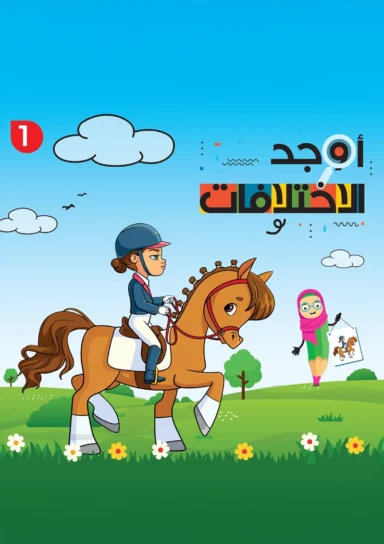
Observation and memory are developed through several classic spot-the-difference games. One page shows a soldier with a tank and jet; another, later in the book, uses a different scene. In each case children are asked to “Find 3 Differences” between the top and bottom images, encouraging them to look closely and compare tiny details.
In a charming dog-themed puzzle, kids must “Find 2 Same Pictures”. Several playful dogs appear in slightly different poses and colours, and only two are exactly alike. Finding the matching pair improves visual discrimination, attention to detail and perseverance.
Two “Back and front” activities extend this idea. In one, children match the front and back views of cute animal characters. In another, they connect different professionals – such as police officers and other workers – from front to back. These tasks develop orientation, spatial reasoning and understanding of how objects look from different angles.
Opposites game, extra matching & maze challenge
A standout page in Use Your Brain 8 is the Opposites game. On one side, children see English words with pictures: SOLID (rock), SWEET (ice cream), MANY and SMALL (a ladybird), and COLD (ice cubes). On the other, they see ONE (single flower), HOT (candle), BIG (whale), SOFT (pillow) and SOUR (lemon slice). Children draw lines between matching pairs of opposites, helping them build a rich English vocabulary for adjectives and their opposites while also thinking conceptually about quantity, temperature, size and texture.
Additional “Match the pictures” pages ask children to connect associated objects, such as tools with their uses or ingredients with finished foods. Near the end, a maze invites kids to “Help the baker reach the pizza”. They trace a safe path through a winding route, combining planning, fine motor control and problem-solving.
All instructions throughout the book are presented in both Arabic and English, making Use Your Brain 8 an excellent bilingual workbook for families and schools. Children repeatedly encounter key phrases like “How Many?”, “Subtraction Fun”, “Choose The Correct Objects”, “Find The Correct Shadow” and “Opposites game” while focusing on the pictures, which supports language learning alongside maths and logic.
Delivered as a printable PDF, this kids brain games workbook is ideal for home use, classrooms, nurseries, tutoring centres and travel. You can print the whole book and bind it, or print individual pages as quick brain-break activities, homework sheets or assessment tools. Reprint favourite puzzles as often as you like – there is always another chance to count, match, compare and think with Use Your Brain 8 – Kids Brain Games, Math & Logic Puzzle Workbook.

There are no reviews yet.